
Maintain and Move: 5 Tips For Using EPDs
Get more out of EPDs this bull sale season with this short clip and 3 minute read expanding on tips #2 and #4.
Make sorting bulls easier on the app => Download BullPEN
1) Phenotype:
It is essential to remember the importance of well-structured cattle and to NOT disregard phenotype over EPDs. At some point during bull selection, whether it is the first or last step, phenotype must always be given heavy consideration.
2) Know your herd and production resources:
Think “maintain and move”. What traits do you want to maintain, and what traits do you want to move?
It’s important to know where you start.
Commercial cattle lack EPDs and many producers tend to keep less data on their cattle than purebred operations, making it difficult to assess certain traits. In such cases, there are a few simple tricks that can help gain perspective on the situation.
Cattle wear attributes such as foot score, calving ease, docility, and fertility on their sleeve, making selecting for traits like these easier. In contrast, while cow-calf producers know the weight of their calves at sale, many ranches lack scales to weigh mature cows and replacement heifers.
One tool for perspective is the weight of open and cull cows when sold at the sale barn through the years. Are your mature cows weighing 1000 lbs or 1400 lbs? Are your cattle uniform? Do you want larger or smaller framed cattle? What percentage of their body weight are the cows weaning? Questions like these can point to areas you might want to maintain or move.
Some EPDs need to fit the environment and available resources. Online tools, such as the American Angus Association’s Optimal Milk Module, help producers find their ideal Milk EPD range. Check with your breed association’s website to find tools and guides.
This critical thinking about herd performance can help a producer see how they want to maintain and move along with what relevant EPDs to consider.
3) Avoid single trait selection:
Overemphasizing any particular trait can lead to an imbalance. Producers have to consider multiple EPDs if they plan to both maintain and move a variety of traits.
Extremes are not always helpful and trade-offs with other EPDs might need to be made.
Swipe & tap breed to see EPD unit guides/definitions

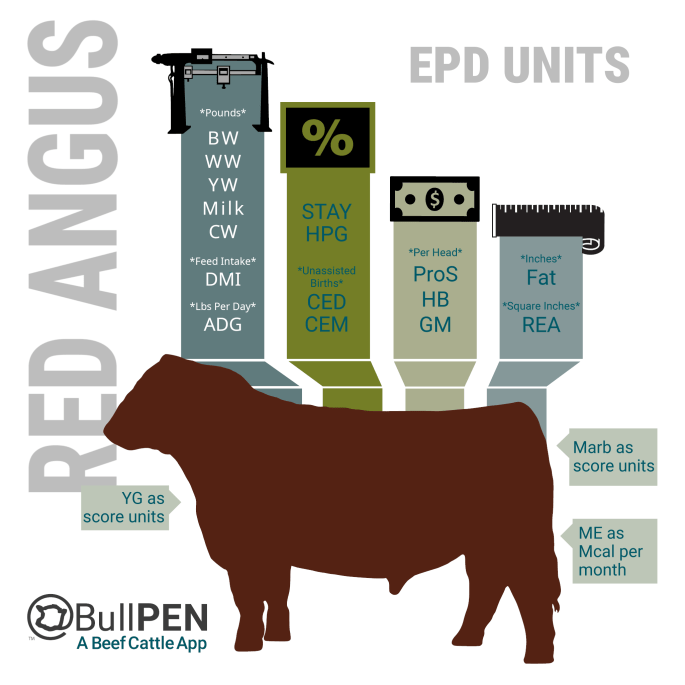
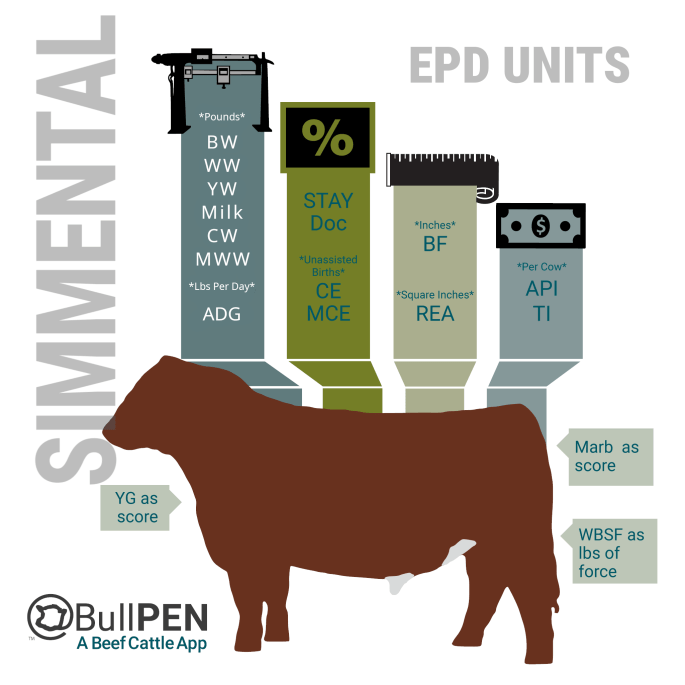


4) Know your EPDs:
Resist selecting for EPDs if you’re not sure what they are, or if you need them.
Knowing what the EPD measures and how it is measured will help to apply it correctly. Before beginning a bull search, careful consideration should be given to why a particular EPD is chosen for selection and what range is acceptable.
What is “good” or “bad” in terms of an EPD is entirely dependent on what is trying to be accomplished in the herd while accounting for available resources.
Most cattlemen have read the short, frequently presented rundown of how to use EPDs. We are all familiar with comparing “Bull A” to “Bull B”, but what if neither of them are suitable for the operation?
Producers should research how bulls compare to their herd and if they will help maintain or move in the desired manner, not just compare them to each other.
Begin with a recent set of EPDs from the bull battery on the ranch, taking into account any changes to EPDs since the original purchase. Most breed associations offer a way to log onto their breed registry site, input the registration numbers, and download EPDs to a spreadsheet. It may be necessary to sort bulls into groups. For instance, heifer bull EPDs may skew the averages of bulls used on cows. The spreadsheet can calculate the minimum, maximum, and average values for each EPD.
This provides a new perspective on the herd bulls and can help determine which EPDs are relevant to tip #2 and what ranges to target.
5) Understand the limits of EPD:
Understanding the limitations of EPDs can help you expect reasonable results.
–heritability i.e. mature height has high heritability at .59 whereas milk is only .12
–accuracy and possible changes i.e. a young bull with low accuracy of .15 could have a CED that changes as much as 9 more/less the current EPD. Genetic testing helps this by increasing the accuracy and reducing the possible change. Additionally, some EPDs may change when the breed association adjusts how they’re calculated.
This is why it’s sometimes helpful to re-check your bulls’ EPDs occasionally, especially if they aren’t performing as hoped.
Genetic progress always takes time.
Louis L’Amour once wrote “Victory is won not in miles but in inches. Win a little now, hold your ground, and later, win a little more.
Have an EPD question?
Drop your questions here and I’ll do my best to find answers from the industry experts!


 BullPEN