Hereford EPDs

Units of Measure:

EPD DEFINITIONS FROM HEREFORD.ORG

  • Calving Ease — Direct (CE) – CE EPD is based on calving ease scores and birth weights and is measured on a percentage. CE EPD indicates the influence of the sire on calving ease in females calving at 2 years of age.
  • Birth Weight (BW) – BW EPD is an indicator trait for calving ease and is measured in pounds.
  • Weaning Weight (WW) – WW EPD is an estimate of pre-weaning growth that is measured in pounds.
  • Yearling Weight (YW) – YW EPD is an estimate of post-weaning growth that is measured in pounds.
  • Dry Matter Intake (DMI) – The DMI EPD predicts the daily consumption of pounds of feed.
  • Scrotal Circumference (SC) – Measured in centimeters and adjusted to 365 days of age, SC EPD is the best estimate of fertility. It is related to the bull’s own semen quantity and quality, and is also associated with age at puberty of sons and daughters.
  • Sustained Cow Fertility – SCF EPD is a prediction of a cow’s ability to continue to calve from three years of age through 12 years of age, given she calved as a two-year-old.
  • Maternal Milk (MM) – The MM EPD of a sire’s daughters is expressed in pounds of calf weaned. It predicts the difference in average weaning weights of sires’ daughters’ progeny due to milking ability.
  • Maternal Milk & Growth (M&G) – The M&G EPD reflects what the sire is expected to transmit to his daughters for a combination of growth genetics through weaning and genetics for milking ability. It is an estimate of the daughter’s progeny weaning weight.
  • Maternal Calving Ease (MCE) – MCE EPD predicts how easily a sire’s daughters will calve at two years of age and is measured on a percentage.
  • Mature Cow Weight (MCW) – The MCW EPD was designed to help breeders select sires that will either increase or decrease mature size of cows in the herd.
  • Udder suspension (UDDR) – UDDR EPDs are reported on a 9 (very tight) to 1 (very pendulous) scoring scale.
  • Teat size (TEAT) – TEAT EPDs are reported on a 9 (very small) to 1 (very large, balloon shaped) scoring scale.
  • Carcass Weight (CW) – CW EPD is a beneficial trait when considering the impact that pounds have relative to end product value. At the same age constant endpoint, sires with higher values for carcass weight will add more pounds of hot carcass weight compared to sires with lower values for carcass weight.
  • Rib Fat (FAT) – The FAT EPD reflects differences in adjusted 365-day, 12th-rib fat thickness based on carcass measurements of harvested cattle.
  • Ribeye Area (REA) – REA EPDs reflect differences in an adjusted 365-day ribeye area measurement based on carcass measurements of harvested cattle.
  • Marbling (MARB) – MARB EPDs reflect differences in an adjusted 365-day marbling score (intramuscular fat, [IMF]) based on carcass measurements of harvested cattle.

    Indexes
  • Baldy Maternal Index (BMI$) – The BMI$ is a maternally focused index that is based on a production system that uses Hereford x Angus cross cows. Progeny of these cows are directed towards Certified Hereford Beef. This index has significant weight on Sustained Cow Fertility, which predicts fertility and longevity of females. There is a slightly positive weight on Weaning Weight, Mature Cow Weight and Milk which accounts for enough growth but ensures females do not increase inputs. There is some negative emphasis on Dry Matter Intake, but a positive weighting on Carcass Weight which is anticipated to provide profitability from finishing of non-replacement females and castrated males. Marbling and Rib-eye Area are also positively weighted to keep the harvested progeny successful for CHB. This index is geared to identify Hereford bulls that will be profitable when used in a rotational cross with mature commercial Angus cows.
  • Brahman Influence Index (BII$) – The BII$ is a maternally focused index that is based on a production system that uses Brahman x Hereford cross cows. Progeny of these cows are directed towards a commodity beef market since Certified Hereford Beef© does not accept Brahman influenced cattle. This index has significant weight on Sustained Cow Fertility, which predicts fertility and longevity of females. There is a slightly positive weight on Weaning Weight, Mature Cow Weight and Milk which accounts for enough growth but ensures females do not increase inputs. There is some negative emphasis on Dry Matter Intake, but a positive weighting on Carcass Weight which is anticipated to provide profitability in finishing non- replacement females and castrated males. Marbling and Rib-eye Area are also positively weighted to keep harvested progeny successful for a variety of commodity based programs. This index targets producers that use Hereford bulls on Brahman influenced cows.
  • Certified Hereford Beef Index (CHB$) – A terminal sire index that is built on a production system where Hereford bulls are mated to mature commercial Angus cows where all progeny will be targeted for Certified Hereford Beef after the finishing phase. This index has significant weight on Carcass Weight and Marbling to ensure profit on the rail. As well there is a positive weighting for Average Daily Gain along with a negative weighting on Dry Matter Intake to ensure efficient pounds of growth in the finishing phase. In addition, there is a positive weighting for Rib-eye Area and a negative weighting for Back Fat to maintain desirable Yield Grades. This is the only index that has no emphasis on fertility. Remember that no replacement heifers are being retained.

Shorthorn EPDs

Units of Measure:

EPD DEFINITIONS FROM SHORThORN.ORG

  • Calving Ease Direct (CED): The CED EPD is listed as a percentage of unassisted calvings. A higher CED EPD predicts a sire that will have a higher percentage of unassisted calves.
  • Birth Weight (BW): Compares the differences in the weight of calves at birth. It is measured in pounds, and cattle with higher BW EPDs are predicted to produce heavier calves.
  • Weaning Weight (WW): The WW EPD is expressed in pounds and predicts differences in weaning weight of a sire’s calves. Bulls with higher WW EPDs predict heavier calves across the scale at weaning.
  • Yearling Weight (YW): Just like WW, only at the next stage of life. The YW EPD is expressed in pounds. Higher YW EPDs are likely to produce bigger, heavier yearlings.
  • Milk (MK): The hardest trait to measure, since we don’t measure milk production in beef cows. The MK EPD is measured in pounds of calf weaning weight due to his mother’s milking ability. A higher MK EPD predicts that a bull will sire daughters who raise heavier calves due to their milk production.
  • Total Maternal (TM): Total Maternal EPD is a simple formula. TM= MK EPD + ½ WW EPD. It measures impact on calf weaning weight due to both milk production and the cow’s genetics for growth. Bulls with a higher TM EPD should sire daughters with a bigger impact on their calves’ weaning weight.
  • Calving Ease Maternal (CEM): Measures the ability of a bull’s daughters to calves unassisted as two year olds. The higher the CEM EPD, the easier calving should be when a bull’s daughters have that first calf.
  • Stayability (ST): Cows who work longer make more money. The ST EPD predicts the ability of a bull to sire cows that “stay around”. The ST EPD is shown as a percentage of how much more likely a bull’s daughters will stay in your herd to the age of 6. A higher ST EPD bull is more likely to have daughters stay around for a long time.
  • Carcass Weight (CW): The CW EPD is all about pounds of beef on the rail. Higher CW EPDs mean that a bull is more likely to sire feeders with heavier carcass weights.
  • Yield Grade (YG): The USDA Yield Grade scoring system is the unit of measurement for the YG EPD. Yield Grade 1 are leaner, more retail product carcasses. Lower, more negative YG EPD bulls are expected to sire calves that score better on the USDA Yield Grade scale.
  • Ribeye Area (REA): REA is measures the size of the muscle that gives us the ribeye in square inches. Higher REA EPDs indicate a bull is expected to produce larger ribeyes in their offspring.
  • Marbling (MB): The MB EPD is in units of percentage of intramuscular fat within the ribeye. Higher MB EPD bulls should sire higher marbling (and grading) feeder calves.
  • Fat Thickness (FT): Inches of backfat (in hundredths of an inch) is the unit of measurement for FT. More negative FT EPDs are indicative of a bull that should sire less backfat in his calves.

    INDEXES
  • $Calving Ease ($CEZ): Genetics that you can trust to calve easy while keeping mature cow size in check. You’ll sleep soundly and your heifers will thank you for selecting for high $CEZ sires.
  • $Balance Merit ($BMI): A balanced, multi-trait index built to identify the ideal seedstock for crossbreeding on British breed cow herds. $BMI focuses on the traits you want in your cows: easy calving, maternal performance and moderate mature size, while keeping the growth and carcass merit in your steer calves.
  • $Cow Productivity ($CPI): An index focused on identifying the cattle that do the things we (and the Shorthorn commercial customer) expect of a productive momma cow: calving unassisted, raising heavy calves to weaning, keeping mature size in check, and staying in the productive herd for years to come.
  • $Feedlot ($F): For the cattleman who sees value in retaining ownership of feeder cattle. Growth, performance and carcass quality drive $Feedlot. Cattle bred to grow and grade excel in $Feedlot.

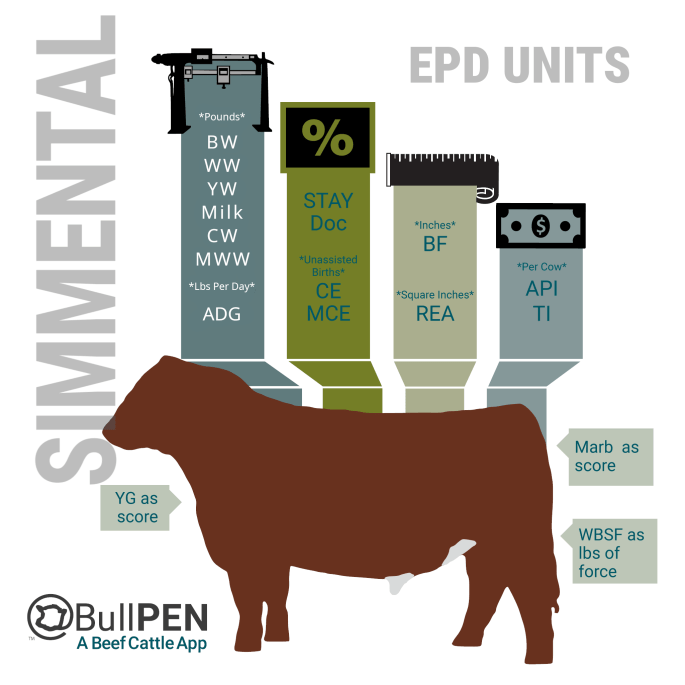
Sim/SimAngus EPDs

Units of Measure:

EPD DEFINITIONS FROM SIMMENTAL.ORG

  • CE: Reported as the difference in percentage of calves being born unassisted out of first-calf heifers, with higher values representing greater calving ease.
  • BW: Reported as the difference in pounds of calf birth weight.
  • WW: Reported as the difference in pounds of progeny weaning weight.
  • YW: Reported as the difference in pounds of progeny yearling weight.
  • ADG: Reported as the difference in post-weaning pounds gained on a daily basis.
  • DMI: Reported as the difference in pounds of daily dry matter intake.
  • MCE: Reported as the difference in percentage of daughters calving unassisted as first-calf heifers.
  • MILK: Reported as the difference in maternal pounds of weaning weight from an individual’s daughters due to milk.
  • MWW: Reported as the pounds of weaning weight expressed in daughters’ progeny due to the milk production of the daughter and the direct genetic effect for weaning growth.
  • STAY: Reported as the difference in probability of a sire’s daughters staying in the herd until 6 years of age, given that they calved as a 2-year-old.
  • DOC: Reported as the difference in yearling-age progeny temperament, represented as a difference in probability that progeny will be scored as a 1, rather than a 2–6 on the docility scale (1 = docile disposition; 6 = extremely aggressive).
  • CW: Reported as the difference in pounds of progeny carcass weight.
  • YG: Reported as the difference in progeny USDA Yield Grade score units (1–5).
  • MARB: Reported as the difference in progeny carcass marbling score.
  • BF: Reported as the difference in inches of external backfat at the 12th and 13th rib.
  • REA: Reported as the difference in square inches of ribeye area between the 12th and 13th rib.
  • $API: Evaluates sires for use on the entire cow herd (bred to both Angus first-calf heifers and mature cows) with the portion of their daughters required to maintain herd size retained and the remaining heifers and steers put on feed and sold on a grid (carcass grade and yield).
  • $TI: Evaluates sires for use on mature Angus cows with all offspring put on feed and sold on a grid (grade and yield).
  • $GAIN: A prediction designed to identify animals that are more profitable in the feedlot by converting feed into weight. $Gain is a combination of DMI and ADG, where ADG is weighted by the value of a pound of gain, and DMI is negatively weighted by the cost of a pound of dry matter. $Gain is expressed as the dollar difference per head per day during the post-weaning period.

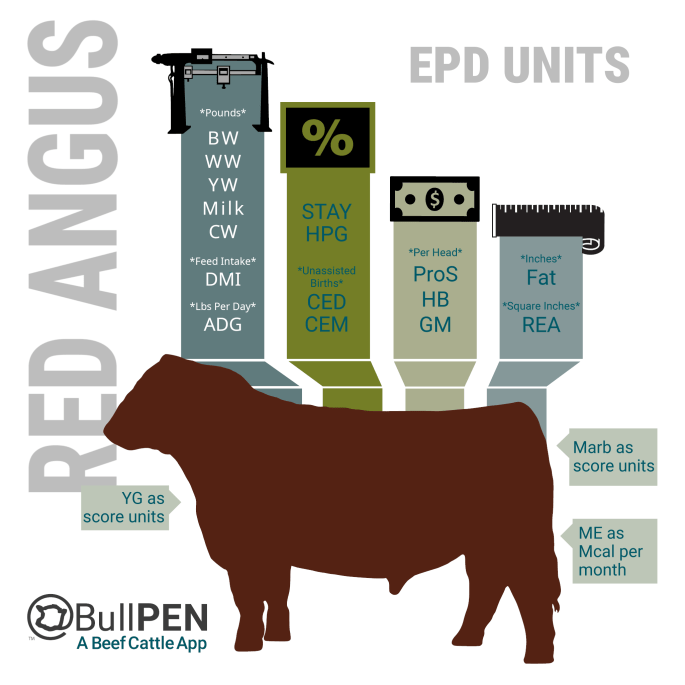
Red Angus EPDs

Units of Measure:

EPD Definitions FROM REDANGUS.org

  • ProS: Profitability and Sustainability is an all-purpose index that predicts average economic differences in all segments in the beef supply chain. This index is a combination of the breeding objectives modeled in the HerdBuilder and GridMaster selection indexes. In this index, replacement heifers are retained from within the herd and all remaining progeny are fed out to slaughter and sold on a quality-based grid. Traits included in this index include calving ease, growth, HPG, STAY, Mature Weight, Dry Matter Intake and carcass traits. The resulting index is expressed in dollars per head born.
  • HB: HerdBuilder is a maternal seleEase Directction index that predicts the economic differences of animals for traits that are important from conception through weaning. Expressed as dollars per head born, HB is calculated based on the scenario that bulls are mated to heifers and cows, replacement heifers are retained and all remaining progeny are marketed at weaning. Traits included in the HB index include Calving Ease Direct, Calving Ease Maternal, Weaning Weight, Milk, Mature Weight, Heifer Pregnancy and Stayability.
  • GM: GridMaster is a selection index that predicts the average economic difference of non-replacement calves through the post- weaning phase of production. GM places selection pressure on growth, feedyard performance and carcass traits. Expressed as dollars per head born, GM is calculated based on the scenario that progeny are fed out to slaughter and marketed on a quality-based carcass grid. Traits included in GM include Average Daily Gain, Carcass Weight, Dry Matter Intake, Marbling, Back Fat and Rib Eye Area.
  • CED: Calving Ease Direct predicts differences in the percent of calves born unassisted out of 2-year-old dams.
  • BW: Birth Weight predicts differences in actual birth weight of progeny.
  • WW: Weaning Weight predicts differences in 205-day weaning weight.
  • YW: Yearling Weight predicts differences in 365-day yearling weight.
  • ADG: Average Daily Gain predicts differences in weight gain between 205 and 365 days of age.
  • DMI: Dry Matter Intake predicts differences in daily feed intake as measured in a feedlot during the post-weaning period.
  • MILK: Milk predicts differences in weaning weight attributed to the milking ability of the animal’s daughters.
  • ME: Maintenance Energy predicts the difference in maintenance energy requirements.
  • HPG: Heifer Pregnancy predicts differences in the percent of daughters who are able to conceive and calve at 2 years of age following exposure to breeding.
  • CEM: Calving Ease Maternal predicts differences in the percent of daughters who are able to calve unassisted as 2-year-old heifers.
  • STAY: Stayability predicts differences in the ability of an animals’ retained daughters to remain productive in the herd – calve every year – through 6 years of age.
  • MARB: Marbling predicts differences in marbling score – amount of intramuscular fat measured at the 13th rib.
  • YG: Yield Grade predicts differences in USDA Yield Grade, which is calculated using CW, REA and Fat.
  • CW: Carcass Weight predicts differences in actual hot carcass weight.
  • REA: Ribeye Area predicts differences in square inches of ribeye area measured at the 13th rib.
  • FAT: Fat predicts differences in the depth of backfat measured between the 12th and 13th ribs.

Angus EPDs

Units of Measure:

EPD Definitions FrOM Angus.org

Maternal

  • Heifer Pregnancy (HP), is a selection tool to increase the probability or chance of a sire’s daughters becoming pregnant as first-calf heifers during a normal breeding season. A higher EPD is the more favorable direction and the EPD is reported in percentage units.
  • Calving Ease Maternal (CEM), is expressed as a difference in percentage of unassisted births with a higher value indicating greater calving ease in first-calf daughters. It predicts the average ease with which a sire’s daughters will calve as first-calf heifers when compared to daughters of other sires.
  • Maternal Milk EPD (Milk), is a predictor of a sire’s genetic merit for milk and mothering ability as expressed in his daughters compared to daughters of other sires. In other words, it is that part of a calf’s weaning weight attributed to milk and mothering ability.
  • Mature Weight EPD (MW), expressed in pounds, is a predictor of the difference in mature weight of daughters of a sire compared to the daughters of other sires.
  • Mature Height EPD (MH), expressed in inches, is a predictor of the difference in mature height of a sire’s daughters compared to daughters of other sires.
  • Cow Energy Value ($EN), expressed in dollar savings per cow per year, assesses differences in cow energy requirements as an expected dollar savings difference in daughters of sires. A larger value is more favorable when comparing two animals (more dollars saved on feed energy expenses). Components for computing the cow $EN savings difference include lactation energy requirements and energy costs associated with differences in mature cow size.

Management

  • Docility (Doc) EPD, is expressed as a difference in yearling cattle temperament, with a higher value indicating more favorable docility. It predicts the average difference of progeny from a sire in comparison with another sire’s calves. In herds where temperament problems are not an issue, this expected difference would not be realized.
  • Claw Set EPD (Claw), is expressed in units of claw-set score, with a lower EPD being more favorable indicating a sire will produce progeny with more ideal claw set. The ideal claw set is toes that are symmetrical, even and appropriately spaced.
  • Foot Angle EPD (Angle), is expressed in units of foot-angle score, with a lower EPD being more favorable indicating a sire will produce progeny with more ideal foot angle. The ideal is a 45-degree angle at the pastern joint with appropriate toe length and heel depth.
  • Pulmonary arterial pressure EPD (PAP), is expressed in millimeters of Mercury (mmHg), with a lower EPD being more favorable indicating a sire should produce progeny with a lower PAP score. PAP score is an indicator of susceptibility to high altitude disease commonly experienced at elevations greater than 5,500 feet. Selection for this trait aims to improve the genetic potential for a sire’s progeny to have lower PAP scores thus a lower chance of contracting high altitude disease increasing the environmental adaptability of cattle living in mountain areas.
  • Hair Shed EPD (HS), is expressed in units of hair shed score, with a lower EPD being more favorable indicating a sire should produce progeny who shed their winter coat earlier in the spring. Selection for this trait should improve the genetic potential for a sire’s progeny to shed off earlier increasing the environmental adaptability of cattle living in heat stressed areas and producers grazing endophyte-infected (hot) fescue.

Carcass

  • Carcass Weight EPD (CW), expressed in pounds is a predictor of the differences in hot carcass weight of a sire’s progeny compared to progeny of other sires.
  • Marbling EPD (Marb), expressed as a fraction of the difference in USDA marbling score of a sire’s progeny compared to progeny of other sires.
  • Ribeye Area EPD (RE), expressed in square inches, is a predictor of the difference in ribeye area of a sire’s progeny compared to progeny of other sires.
  • Fat Thickness EPD (Fat), expressed in inches, is a predictor of the differences in external fat thickness at the 12th rib (as measured between the 12th and 13th ribs) of a sire’s progeny compared to progeny of other sires.

$Value Indexes

  • Maternal Weaned Calf Value ($M), an index, expressed in dollars per head, predicts profitability differences from conception to weaning with the underlying breeding objective assuming that individuals retain their own replacement females within herd and sell the rest of the cull female and all male progeny as feeder calves. The model assumes commercial producers will replace 25% of their breeding females in the first generation and 20% of their breeding females in each subsequent generation. Traits included are as follows: calving ease direct, calving ease maternal, weaning weight, milk, heifer pregnancy, docility, mature cow weight, claw set and foot angle.
  • Weaned Calf Value ($W), an index, expressed in dollars per head, to predict profitability differences in progeny due to genetics from birth to weaning. The underlying objective being producers will retain 20% of the female progeny as replacements and sell the rest of the cull females and their male counterparts as feeder calves. Traits included are as follows (in no particular order): birth weight, weaning weight, milk, and mature cow weight.
  • Feedlot Value ($F), an index, expressed in dollars per head, to predict profitability differences in progeny due to genetics for postweaning feedlot merit compared to the progeny of other sires. The underlying objective assumes producers will retain ownership of cattle through the feedlot phase and sell fed cattle on a carcass weight basis, but with no consideration of premiums or discounts for quality and yield grade. Traits contributing directly to the index are as follows: yearling weight (gain), carcass weight and dry-matter intake.
  • Grid Value ($G), an index, expressed in dollars per carcass, to predict profitability differences in progeny due to genetics for carcass grid merit compared to progeny of other sires. The underlying objective assumes producers will market cattle on an above-industry-average carcass grid. Traits included in the index are as follows (in no particular order): carcass weight, marbling, ribeye area, and fat.
  • Beef Value ($B), a terminal index, expressed in dollars per carcass, to predict profitability differences in progeny due to genetics for postweaning and carcass traits. This terminal index assumes commercial producers wean all male and female progeny, retain ownership of these animals through the feedlot phase and market these animals on a carcass grid. Traits included in the index are as follows: yearling weight, dry-matter intake, marbling, carcass weight, ribeye area and fat.
  • Combined Value ($C), an index, expressed in dollars per head, which includes all traits that make up both Maternal Weaned Calf Value ($M) and Beef Value ($B) with the objective that commercial producers will replace 20% of their breeding females per year with replacement heifers retained within their own herd. The remaining cull heifer and steer progeny are then assumed to be sent to the feedlot where the producers retain ownership of those cattle and sell them on a quality-based carcass merit grid. Expected progeny differences (EPDs) directly influencing a combined index:
    • calving ease direct (CED) and maternal (CEM)
    • weaning weight (WW)
    • yearling weight (YW)
    • maternal milk (Milk)
    • heifer pregnancy (HP)
    • docility (DOC)
    • mature cow weight (MW)
    • foot angle (Angle)
    • claw set (Claw)
    • dry matter intake (DMI)
    • marbling (Marb)
    • carcass weight (CW)
    • ribeye area (RE)
    • fat thickness (Fat)